
For two decades the "Search Engine Optimization" playbook was static. It was a game of keywords, backlinks, and technical hygiene designed to rank your URL among ten blue links on a Google search result page (SERP). We built entire industries around fighting for the Title Tag, the Meta Description, and the Click Through Rate.
That game is evolving.
We are witnessing a fundamental expansion in information retrieval. Users are no longer just searching for documents; they are often searching for answers.
When a user asks ChatGPT, Perplexity, or Google's SGE (Search Generative Experience) a complex question like "What is the best CRM for a Series A B2B startup focused on sales led growth?", they often want more than a list of 10 generic "Top 10 CRM" listicles. They want a synthesized, reasoned answer.
This doesn't mean traditional search result pages are going away. They remain critical for discovery. However, a new layer has been added. In the age of Answer Engines, if you aren't part of the synthesis, you are missing a critical opportunity for visibility.
This is the dawn of AI Visibility.
The Shift: From Indexing to Synthesis
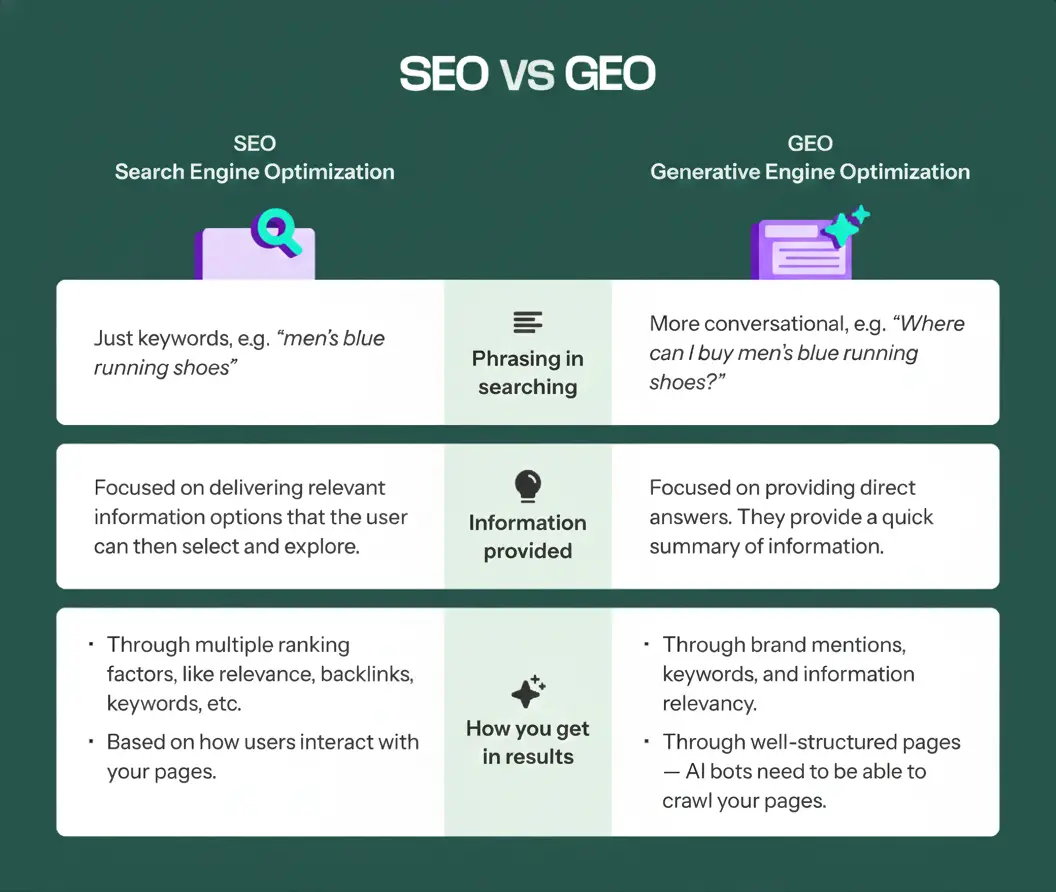
To understand how to adapt, we must first understand the mechanism at play. Traditional search engines work on an Index, Retrieve, Rank model:
- Crawl: Find the page.
- Index: Store the page.
- Rank: Order the page based on heuristics (backlinks, keywords).
Answer Engines (LLMs and RAG systems) add a new layer: Ingest, Synthesize, Generate:
- Ingest: Read and "understand" the semantic meaning of the content.
- Synthesize: Connect facts from your content with facts from authoritative sources.
- Generate: Construct a completely new answer using your brand as a data point or citation.
Gartner predicts that by 2026 search engine volume will shift significantly due to chatbots and virtual agents. The metric of success is expanding beyond just "Session Duration" or "CTR". It now includes Share of Model. How frequently and favorably your brand is cited in AI generated responses.
Why Traditional Content Can Fall Short
Most B2B content marketing is written for humans to skim rather than for machines to understand. We write catchy hooks, use metaphors, bury the lede, and gate our best insights behind PDFs.
LLMs often struggle with this.
When an LLM parses your content, it isn't "impressed" by your wit. It is looking for:
- Entities: distinct concepts (e.g. "Vector Database", "Semantic Search").
- Relationships: how entities relate.
- Assertions: verifiable facts.
If your blog post is 80% fluff and 20% value, the LLM treats it as noise. "Fluff" increases the token cost and dilutes the semantic density of your page. High performing content in the AI era is dense, structured, and authoritative.
How to Optimize for Answer Engines (AEO)
Answer Engine Optimization (AEO) functions alongside traditional SEO. It is about Knowledge Graph Optimization. You need to teach the AI who you are and why you matter.
1. Structure Your Data Like a Database
LLMs are probabilistic machines, but they crave deterministic data. You must make it easy for them to extract facts.
- Schema Markup: Don't just rely on standard Article schema. Use
FAQPage,HowTo, and nestedOrganizationschemas to explicitly define relationships. - Table Data: LLMs excel at reading tables. If you are comparing products, use a clean HTML table. Do not hide comparisons in paragraphs of text.
- Clear Headings: Your H2s and H3s should be questions or clear entity statements.
2. Own the "Zero Shot" Answer
When an AI generates an answer, it looks for a "seed" of truth. You want your content to be that seed.
- The "Definition" Block: Start your technical articles with a clear, encyclopedic definition of the core topic. This increases the likelihood of being picked up as a Featured Snippet or the grounding truth for an answer.
- Direct Answers: If the title of your section is a question, the very first sentence should be the direct answer. Nuance can come later.
3. Build Authority via "Co Citation"
AI determines truth by proximity. If your brand is frequently mentioned alongside authoritative entities in your niche, the model learns that you belong in that cluster.
- External Links: Cite authoritative sources. It helps the AI map your content to the existing "truth geography" of the web.
- Brand Entity Association: Ensure your brand name is grammatically associated with your core value proposition.
The Future is Hybrid
The uncomfortable truth for many marketers is that traffic patterns are changing. However, qualified traffic, citations, brand awareness, and high intent conversions, will grow for those who adapt to this hybrid landscape.
When a CEO asks their AI assistant "Find me a solution that automates SEO content for my dev tool," the goal is for the assistant to say "I recommend [Your Brand]. It integrates directly with your codebase and is designed specifically for B2B SaaS."
The era of 10 blue links isn't dead, but it has company.
Long live the Answer.